You're about to make a major business move. Make sure the decision can survive the evidence.
Elya researches the commercial property, vendor, product line, or commercial opportunity in front of you, checks the sources, challenges the assumptions, and gives you a written brief on what the evidence supports.
The decision remains yours.
Build the evidence before you commit to a major business decision.
The hard part isn't finding information. It's knowing what should change the decision.
A commercial property can look promising until you understand the area. A vendor can look strong until you check what people who work with it actually say. A product line can look attractive until the market, margins, or channel tell a different story.
Elya starts with the decision, separates what is known from what is assumed, checks the sources behind the claims that matter, and looks for the evidence that could actually change the answer.
The goal is not more information. It is a better-supported decision.
You get a written brief showing the sources we checked, what remains uncertain, and what the findings support.
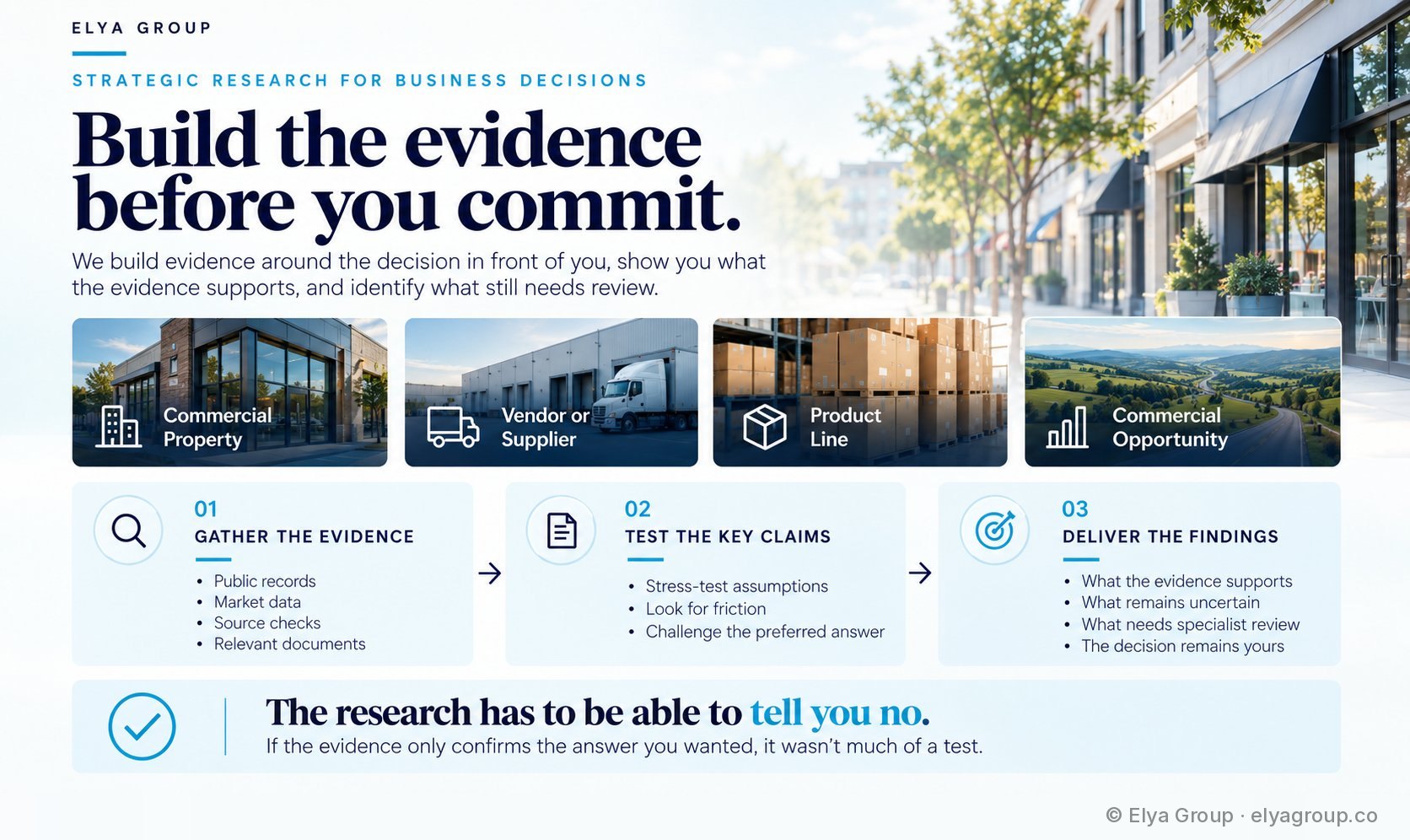
A research brief built around the decision you actually need to make.
The evidence reviewed depends on the question. Each engagement is scoped around the information most likely to materially affect the decision.
Evaluating a commercial property, building, or location. Depending on the situation, Elya may examine traffic patterns, consumer spending and demand, nearby businesses, competing uses, publicly available zoning and land-use information, municipal planning, commercial activity, and other market evidence to identify credible commercial uses worth considering.
Deciding whether to commit to a supplier, product brand, equipment line, or distribution relationship. Elya may examine the company, product reputation, market acceptance, what people who work with it report, channel conditions, customer signals, and other evidence that could materially affect the decision.
Deciding whether a new product line, service, market, or other commercial opportunity is worth pursuing. Elya may examine demand, alternatives, competitors, assumptions, risks, commercial economics supported by the available data, and other evidence needed to determine whether the opportunity deserves more time or money.
Once the decision is made to pursue the opportunity, work involving positioning, pricing strategy, channels, launch, or reaching buyers moves into Go-to-Market Strategy.
When a commercial decision does not fit one of the examples above, Elya can structure a research brief around the specific question, the evidence that could change the answer, and the uncertainty the owner needs to understand before committing.
Scoped individually. The scope, deliverable, stopping point, and fee are agreed before work begins.
Commercial research, not licensed professional advice.
Elya provides market research and commercial analysis. Depending on the question, a decision may also require an attorney, accountant, appraiser, engineer, architect, zoning professional, financial professional, or another licensed specialist.
When that expertise is necessary, we flag it, and we do not claim our research replaces it.
Elya's work does not constitute legal, tax, engineering, architectural, appraisal, or regulated securities or investment advice.
Start with the decision. Research what could actually change it.
Every engagement is designed around the specific choice in front of you. The research may use public records, industry sources, market data, and checks on the sources that matter.
- FactsWhat can be verified.
- AssumptionsWhat is believed but not yet tested.
- UnknownsWhat could still change the answer.
We clarify the choice being made, what is already known, what is being assumed, and which unanswered questions could materially change the answer.
We gather and check the sources that matter and focus on the information most likely to materially affect the decision.
We look for contradictions, competing explanations, hidden constraints, and evidence that does not support the preferred outcome.
The research has to be able to tell you no.
You receive a written brief explaining what the evidence supports, what remains uncertain, and the important tradeoffs you should understand before deciding.
What you bring: the decision you are trying to make and any documents or information already available that could help us understand it.
Bring us the decision.
If you are evaluating a commercial property, a vendor line, or another commercial opportunity, tell us what you're considering and what you need to decide.
Scoped individually. The scope, deliverable, stopping point, and fee are agreed before work begins.
Start a Conversation